Medical Frailty Evaluation
Medicaid medical frailty determination from MMIS claims — built for H.R.1 implementation.
Built for H.R.1 implementation — January 2027 federal deadline
States and Medicaid managed care organizations must identify enrollees who are medically frail and therefore exempt from Medicaid work and community engagement requirements. Each evaluation retrieves MMIS claims for the member, runs a deterministic rules pass against the medical frailty condition library, and returns a clear Exempt or Not Exempt decision with full audit evidence.
40M+
Medicaid expansion adults subject to new work requirements
38 states
Building medical frailty systems from scratch under HR1
$270M
Estimated per-state cost of manual IT system builds
Jan 2027
Federal deadline for state compliance
The January 2027 deadline is real
Pennsylvania DHS is actively designing a claims-based ICD-10 medical frailty review process with a January 2027 go-live target. Commonwealth Fund reports that most states need entirely new IT system builds to identify medically frail enrollees, with cost estimates from under $10 million to over $270 million per state. AgeOptions notes that policy experts recommend developing coding systems and specialized algorithms using diagnostic and service utilization data to identify medically frail individuals, and warns states to carefully choose technology vendors given costly failures in Medicaid IT. Health Affairs states that medical frailty implementation has been scattershot, and says states must rethink how this exemption is implemented before the deadline. ASAM explains that federal law requires states to use available data to determine exemption status without requiring additional documentation from enrollees—ex parte verification first. That is why the next section explains why claims data matters.
As cited by leading health policy organizations
Why claims data matters for medical frailty
Federal statute recognizes medical frailty as an exemption from Medicaid work reporting. Operational success depends on using Medicaid claims and encounter data before asking enrollees for more paperwork.
Medically frail Medicaid enrollees are exempt from work and community engagement requirements—but only when the state or plan can identify them accurately and on time.
Requiring enrollees to self-attest or submit physician forms drives churn: people who meet medical frailty criteria still lose coverage during application or redetermination.
Medicaid eligibility and MMIS systems need repeatable logic—ICD-10 diagnosis codes, utilization thresholds, and lookback periods applied the same way for every enrollee.
Workflow
How medical frailty determination works
Every evaluation runs a deterministic rules pass against MMIS claims before staff review the trace and approve the outcome.
Select member and evaluation mode
Choose Renewal or New Application mode — the member dropdown filters to only matching members. Renewal evaluates existing claims history; new application flags results as advisory and routes insufficient-history cases to manual review.
Retrieve MMIS claims
Pull MMIS EOB and encounter data for the selected member across the configured lookback period. Claims retrieved count is shown separately from claims evaluated after the window is applied.
Rules engine evaluation
Match ICD-10 diagnoses to the medical frailty condition library and return Exempt or Not Exempt. Every exempt result is classified as permanent (chronic), temporary (acute only), or indeterminate.
Review evaluation trace
Staff review the Evaluation Trace — claims retrieved, conditions matched, frailty classification, and final decision — all in one timeline before approving.
Approve and save to member record
Click Approve & Save to write the determination outcome directly to the member's exempt status. Closed-loop workflow — no manual data re-entry, no separate system update.
Built for Medicaid eligibility and MMIS operations
Deterministic rules for the compliance record, plus AI clinical review on every run so staff see when code-table logic may have missed a medically frail pattern.
Eligibility lookback periods
Server-enforced 1–24 month windows aligned to how states apply medical frailty at application, renewal, and redetermination.
Medicaid claims evaluation
Processes MMIS-style EOB and encounter layouts with ICD-10-CM matching, inpatient/outpatient thresholds, and procedure-based rules.
Medical frailty conditions
Evaluates the full CMS chronic condition exemption catalog in one pass — serious and complex medical conditions, substance use disorders, and disabling mental disorders.
Defensible audit trail
Returns matched conditions, qualifying claim IDs, diagnosis codes, and policy text for Medicaid compliance and fair hearings.
State-configurable rules
Chronic condition and ICD-10 mappings maintained centrally so states can align with their medical frailty definition without code changes.
Eligibility system integration
REST API for Medicaid eligibility and MMIS batch jobs, plus a review UI for eligibility staff and managed care teams.
Member roster integration
API-driven member dropdown pulls directly from your Medicaid member roster. Staff select members by name or ID — no manual entry, no transcription errors.
Closed-loop status update
Approve & Save writes the determination outcome directly to the member's exempt status via the members API. Evaluation results flow into the member record instantly.
Permanent vs. temporary frailty classification
Every exempt determination is automatically classified as permanent (chronic conditions), temporary (acute events only), or indeterminate — guiding staff on the correct exemption period.
Application vs. renewal evaluation mode
Two modes with distinct logic: renewals evaluate against existing claims history; new applications flag insufficient claims history for manual review and treat results as advisory.
Rules Engine
How medical frailty rules are stored and enforced
CE conditions and ICD-10 code mappings live in a PostgreSQL database. The rules engine loads them at startup, caches them for 60 minutes, and applies them deterministically on every evaluation — no code change required to update a rule.
Example conditions (from the database)
A single IP claim with any AMI code qualifies. Procedure flag alone also qualifies.
Requires sustained utilization pattern — single encounter is not sufficient.
Uncomplicated diabetes codes (E11.9, E11.00) are excluded — complications must be present.
ESRD (N18.6) with dialysis procedure code qualifies on a single claim.
- 1. Apply server-enforced lookback window to filter claims by service date
- 2. For each condition, match claim ICD-10 codes against
ce_icd10_codes - 3. If a matched code is also in
is_excluded = true, it does not count - 4. Count qualifying IP claims, OP claims, and procedure flags separately
- 5. Condition is met when any threshold is satisfied
- 6. Member is Exempt when at least one condition is met — non-exempt indicators on other claims do not override
Database schema
Rules loaded from Supabase PostgreSQL · cached 60 min · no rule changes require code deploys
At first request after a cold start, the engine queries ce_conditions and ce_icd10_codes from Supabase PostgreSQL and holds them in serverless function memory for 60 minutes. Subsequent evaluations within the window hit memory — no database round-trip.
Add or modify a condition in the database — update the row in ce_conditions or insert/delete rows in ce_icd10_codes. The change takes effect within 60 minutes on all instances with no code deploy.
Review UI
Rules-first decisions—with a clinical safety net
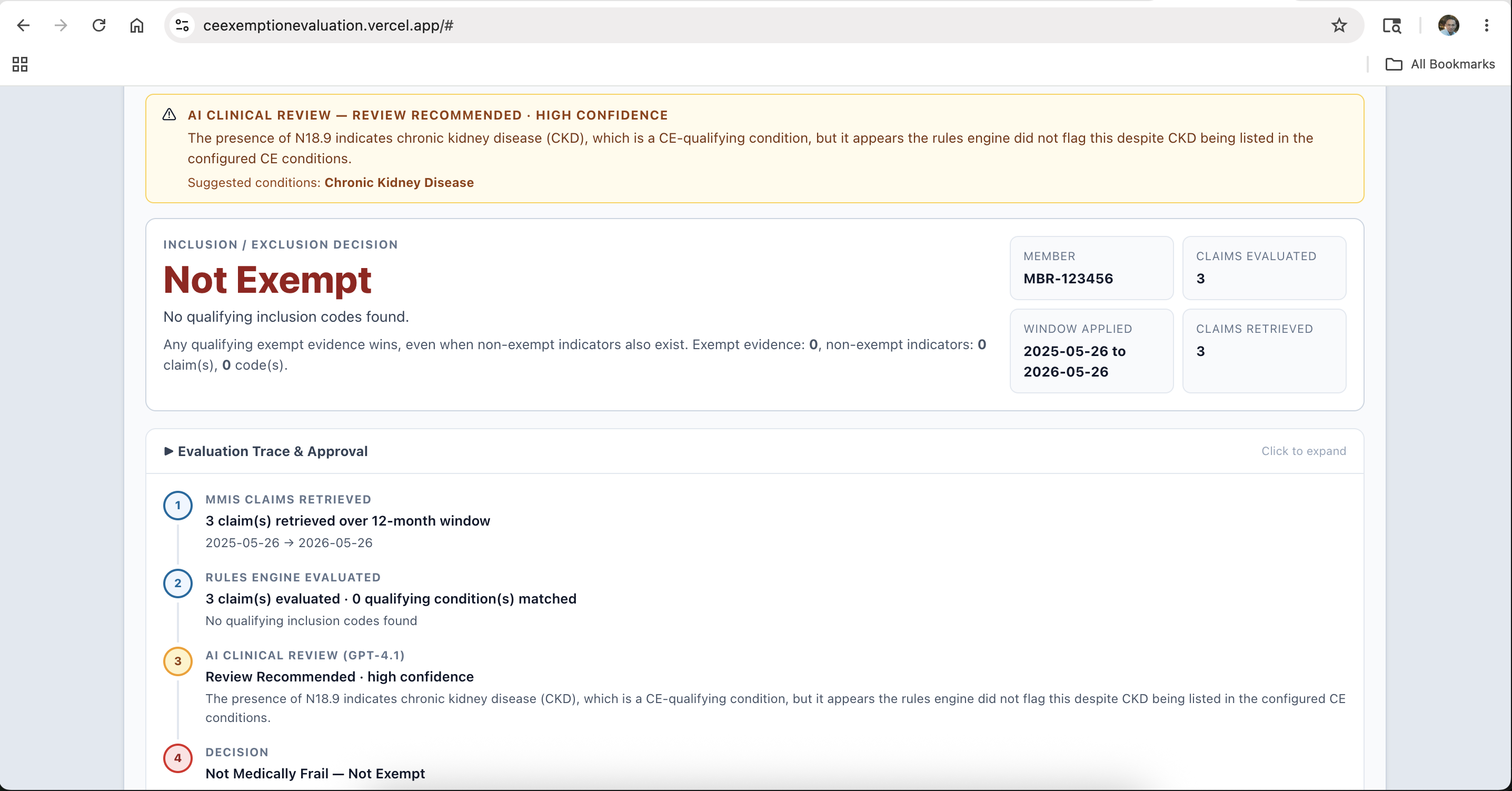
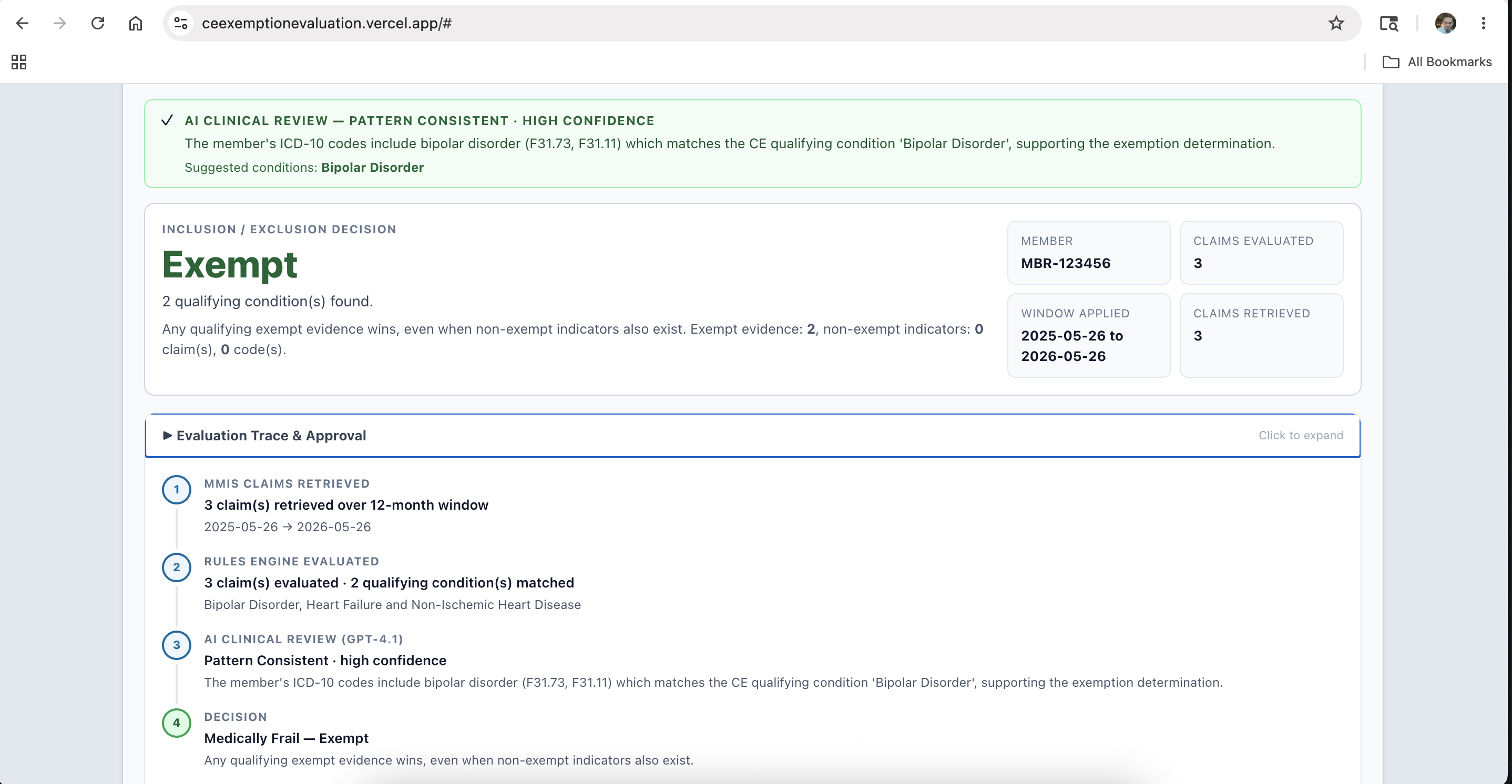
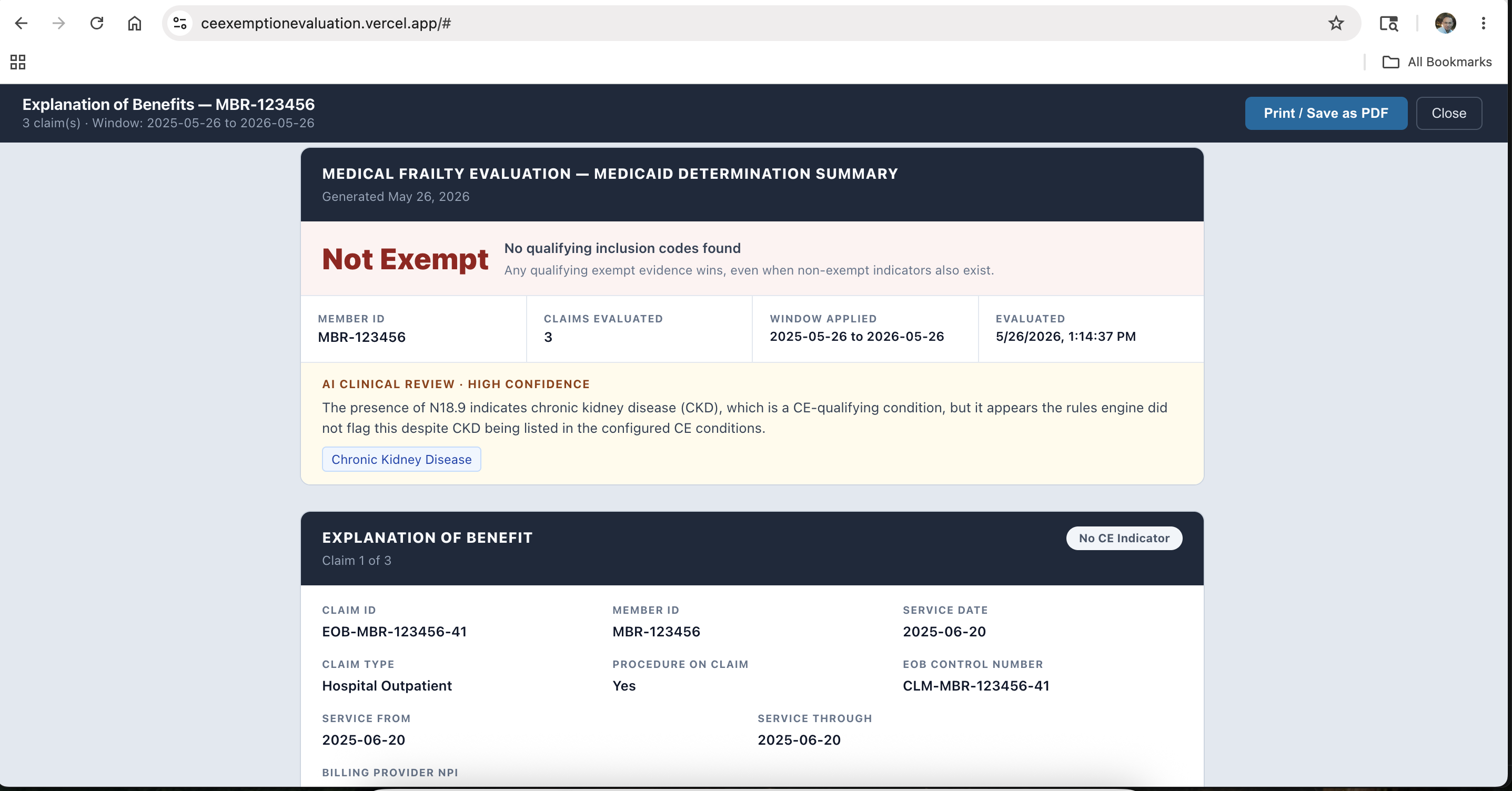
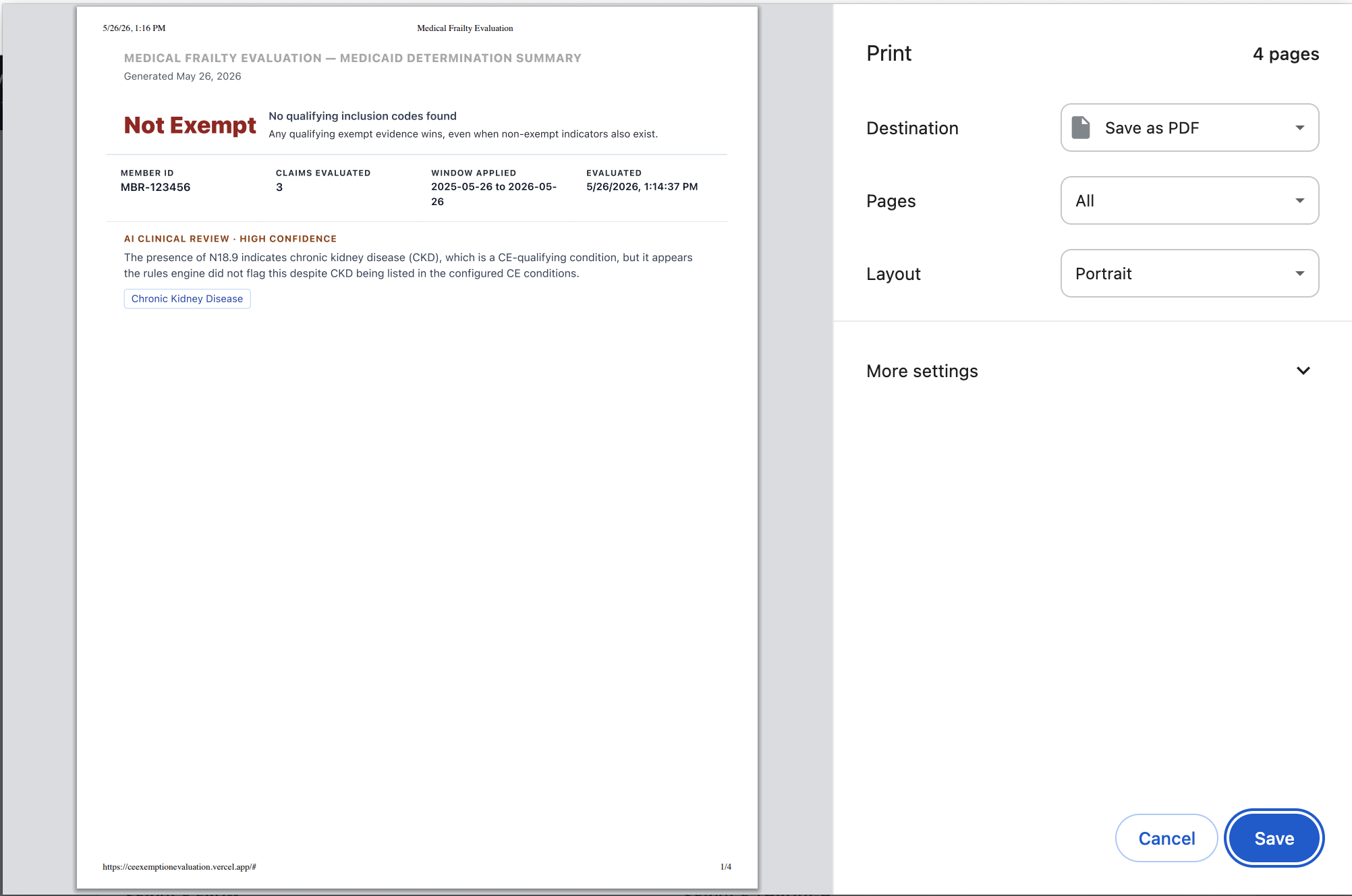
After each search, staff see the rules outcome and the AI Clinical Review banner in the same screen—then qualification evidence, claim drill-down, and PDF export. Screenshots below follow that order.
For Medicaid IT
Integrate with eligibility and MMIS
Connect batch jobs from Medicaid eligibility systems, MMIS, or managed care data warehouses — or use the interactive demo for business validation.
Endpoints
- POST
/api/mmis-eob-retrievalRetrieve MMIS EOB and encounter history for a member over a date range.
- POST
/api/evaluate-v2Medical frailty evaluation — server-enforced lookback window, ICD-10 rules engine, Exempt / Not Exempt decision with full audit evidence.
- GET
/api/icd-lookup?codes=I21.09ICD-10-CM code descriptions for analyst review and UI display.
- GET
/api/membersRetrieve Medicaid member roster for dropdown population and member lookup.
- POST
/api/update-member-statusWrite Exempt / Not Exempt determination outcome to the member record after staff approval.
Production credentials are provided to authorized state and plan integrators. Contact us for a Medicaid pilot environment, or use the live demo with synthetic claims.
Request
curl -X POST https://your-host/api/evaluate-v2 \
  -H "Authorization: Bearer <token>" \
  -H "Content-Type: application/json" \
  -d '{
    "member_id": "MBR-123456",
    "window_months": 12,
    "claims": [
      {
        "claim_id": "CLM-001",
        "claim_type": "IP",
        "service_date": "2026-03-15",
        "icd10_codes": ["I21.09"],
        "has_procedure_code": true
      }
    ]
  }'
Response
{
  "success": true,
  "data": {
    "member_id": "MBR-123456",
    "is_exempt": true,
    "matched_conditions": [
      {
        "condition_name": "Acute Myocardial Infarction",
        "matched_codes": ["I21.09"],
        "rule_summary": ">=1 inpatient claim(s)"
      }
    ],
    "window_applied": {
      "start_date": "2025-05-01",
      "end_date": "2026-05-01"
    }
  }
}
Security and Medicaid compliance
Designed for programs where medical frailty determinations must be traceable, access-controlled, and supportable in eligibility records.
Controlled Medicaid access
Signed-in access for eligibility and care management staff. Production API access is limited to authorized state and managed care environments.
Determination audit log
Each medical frailty run records enrollee ID, outcome, matched chronic conditions, and timestamps for Medicaid quality and compliance review.
Configurable frailty rules
Chronic condition exemption and ICD-10 mappings are maintained centrally so states can align with their medical frailty policies without redeploying code.
See Medicaid medical frailty determination in action
Use the public demo with synthetic Medicaid claims, or contact us for a guided walkthrough, pilot access, and eligibility system integration planning.